Dub vs Rewardful for Stripe SaaS (2026): $49 a month, or $90 plus 5% of every payout?
Rewardful Starter is $49 a month with no payout fee. Dub is $90 plus 5% of everything you pay partners. I ran both at four commission rates looking for one where Dub wins. PartnerStack won't quote most of its plans until the demo.
Pay your affiliates $980 in a month and Dub's 5% payout fee comes to $49. That's Rewardful Starter's entire monthly bill, before Dub's $90 plan fee even starts. That's the whole Dub vs Rewardful gap for a Stripe SaaS: Dub takes a cut of every payout, and Rewardful only takes one if you hand it the payouts.
I ran the bills at four commission rates and two program sizes, looking for a case where Dub comes out cheaper. On published prices there isn't one. At $7,500 in monthly affiliate revenue and a 20% commission, Dub is $165 and Rewardful is $49. Add Rewardful's Managed Payouts at 3% and it's $94, still well under.
So the reason to pick Dub isn't price, and it isn't mainly who sends the money either: Rewardful's Managed Payouts pays affiliates too, for 3%, and says it "handles payouts and tax compliance" without saying which forms. Dub spells it out: W-9s, W-8s, and a 1099-NEC for any US partner it pays $600 or more. If the bill decides it, buy Rewardful.
PartnerStack is further down. It publishes one price, for its self-serve Spark plan, and quotes everything else on a demo call.
Everything here comes from what each vendor publishes about itself, checked Nov 10, 2026, with Dub and Rewardful checked again Nov 11. I haven't run any of the three in production, and anything I couldn't confirm says not verified.
Quick comparison
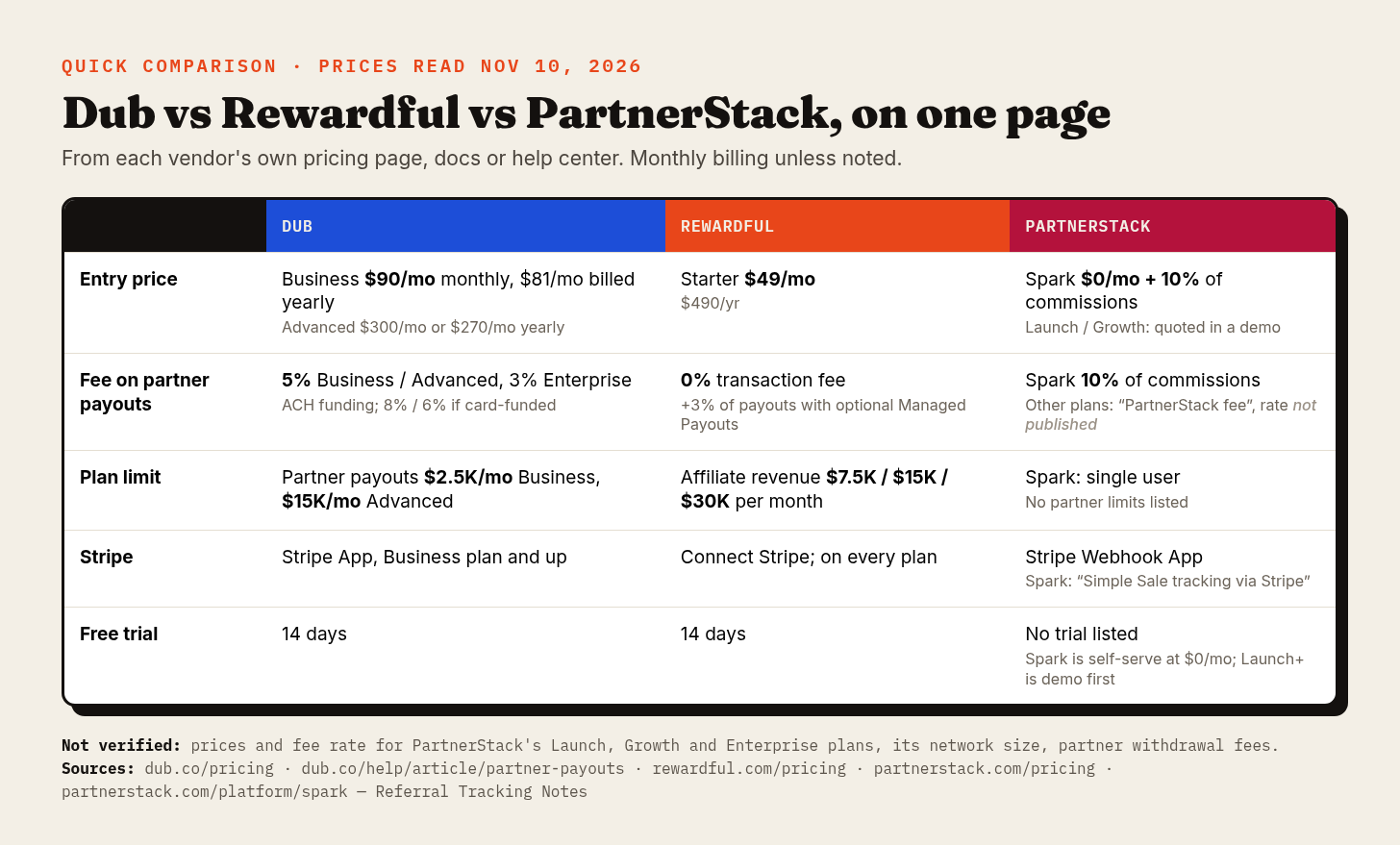
What Dub vs Rewardful costs at your commission rate
The two meter different things. Rewardful caps plans by affiliate-attributed revenue. Dub caps them by partner payouts, then takes a cut of each payout.
Rewardful's pricing page: Starter is $49 a month for up to $7,500 a month in affiliate revenue, Growth is $99 for up to $15,000, and Enterprise starts at $149 for up to $30,000 on its entry tier, with higher tiers above. Yearly billing is 12 months for the price of 10, so $490, $990 and $1,490 and up. Every plan has unlimited affiliates and a 0% transaction fee. Starter is limited to one campaign and two team members.
Dub's pricing page opens on the yearly view, with a "10%" badge, where Business and Advanced show as $81 and $270. Monthly, they're $90 and $300. Business covers $2,500 a month in partner payouts ($30K a year) and up to 500 partners. Advanced covers $15,000 a month ($180K a year) with unlimited partners. Enterprise is custom annual billing. The payout fee is 5% on Business and Advanced and 3% on Enterprise when you fund by ACH, or 8% and 6% by card (payouts help). Paid plans have a 14-day trial, and non-profits and open-source projects get 25% off. The same monthly prices and caps are in Dub's own Dub vs Rewardful post.
Your commission rate connects the two, since payouts are revenue times your rate. Rewardful Starter always covers $7,500 in revenue. Dub Business covers $2,500 divided by your rate: $16,667 at 15%, $12,500 at 20%, $7,500 at 33.3% and $5,000 at 50%. So under a third, Dub's entry plan stretches further. It's still the bigger bill.
At $7,500 a month in affiliate revenue (Dub is plan plus 5% by ACH; Rewardful is $49, or $49 plus 3% with Managed Payouts):
- 15% commission, $1,125 in payouts. Dub $146.25. Rewardful $49, or $82.75 managed.
- 20%, $1,500 in payouts. Dub $165. Rewardful $49, or $94 managed.
- 33.3%, $2,500 in payouts. Dub $215. Rewardful $49, or $124 managed.
- 50%, $3,750 in payouts, which pushes Dub to Advanced. Dub $487.50. Rewardful $49, or $161.50 managed.
At $15,000 a month, where Rewardful moves to Growth at $99:
- 15%, $2,250 in payouts. Dub $202.50. Rewardful $99, or $166.50 managed.
- 20%, $3,000, so Dub needs Advanced. Dub $450. Rewardful $99, or $189 managed.
- 33.3%, $5,000. Dub $550. Rewardful $99, or $249 managed.
- 50%, $7,500. Dub $675. Rewardful $99, or $324 managed.
Even with Managed Payouts, Rewardful's bill never reaches Dub's in those lists, and at that point both are paying your partners for you. The premium you pay Dub covers tax-form handling it documents, plus holds on disputed sales on Advanced.
The lists use monthly prices and ignore your own time and the PayPal or Wise fees if you pay Rewardful affiliates yourself. Same math for FirstPromoter is in Dub Partners vs FirstPromoter.
PartnerStack, the one without a price tag
PartnerStack's pricing page names Launch, Growth and Enterprise and prices none of them: "Your final plan and pricing are confirmed during your demo." The one public price is Spark, the self-serve plan, at $0 a month plus a 10% processing fee on the commissions you pay out (PartnerStack Spark). On the other plans the fee is "a percentage (known as a PartnerStack fee) on your partner commission invoice total," and you ask your Customer Success Manager what it is (Company FAQs). The Launch and Growth prices you'll see elsewhere come from competitors' blogs, so I've left them out.
Correction, Nov 10, 2026: an earlier version said PartnerStack publishes no prices and quoted Dub's blog for its plan prices. Spark is public, and I removed Dub's figures about PartnerStack. When Spark beats Dub, Rewardful and Tolt: see PartnerStack alternatives: what leaving actually costs.
Stripe setup and referral tracking
Dub installs from the Stripe App Marketplace and needs Business or higher. It listens for customer.created, checkout.session.completed, invoice.paid, charge.refunded and dispute events, handles subscriptions and one-time payments, counts free trials as leads, strips tax out of sale amounts and splits multi-line invoices by product. On the tracking side, a small Analytics script stores the dub_id click ID in a first-party cookie, your backend sends a server-side lead event with customerExternalId, and you pass the same ID as metadata.dubCustomerExternalId on the Checkout Session. Promo codes and Payment Links need less code and give up some attribution detail. (Stripe docs). Expect to touch your backend.
Rewardful connects to your Stripe account and gets webhooks for customer and invoice events. When Stripe creates a customer, Rewardful looks for a referral attribute in its metadata, works out commissions from what the customer actually paid after discounts, and recalculates on full or partial refunds (How Rewardful uses Stripe). Its script reads ?via=token links, stores the referral ID in a cookie (Rewardful.referral) and can add a hidden referral field to your signup forms. If nobody can touch the backend, rewardful('convert', { email }) works from the front end, but it needs read-write Stripe access and only works for Stripe customers created in the last 24 hours (JavaScript API). Every plan includes coupon code tracking, first-touch or last-touch attribution, automatic adjustments for upgrades, downgrades, cancellations and free trials, and a "two-way Stripe sync" (pricing).
PartnerStack has a Stripe Webhook App that records charge events by default or invoice.payment_succeeded instead, "not both," and its team flips the switch for you. Charge events record amount, invoice events record subtotal. It matches customers by customer_key, then Stripe customer ID, then email. Through the app it defaults to email, so set customer_key in Stripe metadata, as PartnerStack recommends. New vendors haven't been able to use manual webhooks since Feb 2024 (Stripe Payment Tracking). On the page, PartnerStackJS stores the partner key in a first-party cookie and your code calls createSignup with a customer key, with a server-to-server API as the backend option (link tracking docs). On Launch you choose affiliate link tracking or lead and deal registration, not both. Enterprise gets both (pricing).
Paying affiliates
On Dub, commissions sit through a hold (default 30 days, anywhere from 0 to 90). Then you review pending payouts, click "Confirm payouts", and Dub pays the partners, PayPal among its methods. ACH payouts take up to 4 business days. Dub collects W-9s and W-8s and issues a 1099-NEC to each US partner who reaches $600 (payouts help).
On Rewardful, every plan gets PayPal mass payouts and Wise bulk payouts, and Enterprise adds one-click PayPal (pricing). With Managed Payouts you pay one invoice and Rewardful pays the affiliates and "handles payouts and tax compliance." It needs an ACH-capable funding account, which Rewardful doesn't debit automatically (FAQ). Affiliates pay their own withdrawal fees: $1.00 for ACH, $0.75 plus 2% for PayPal (capped at $1.75 for US residents and $20.75 for everyone else), $10 to $15 for wires, and 1.9% to 3% for currency conversion (withdrawal fees). Dub's comparison post says Rewardful offers no tax help. Rewardful's FAQ says otherwise, and I'll take a vendor's word about itself over its competitor's.
PartnerStack invoices a month's commissions on the 1st, gives you seven days to review, charges on the 8th, and partners can withdraw around the 13th (Company FAQs). Its partner withdrawal fees are not verified.
Refunds and chargebacks
Refund before the commission is paid, and all three handle a full refund. Dub detects it on Business and up, marks the commission Refunded and pulls it from pending payouts. Rewardful deletes the commission on a full refund and recalculates it on a partial one. PartnerStack deletes the transaction on a full refund and, on a partial one, replaces it with one for whatever's left. Dub's docs don't say what happens on a partial refund.
Refund after it's paid, and it's manual everywhere. Dub has you add a clawback, a negative commission that comes off the partner's next payout. Rewardful: "You (the merchant) need to handle the overpayment manually." PartnerStack doesn't say.
Holding periods give refunds time to land. Dub offers 0, 7, 14, 30 (default), 60 or 90 days. Rewardful keeps commissions pending 30 days by default, adjustable. PartnerStack's is unknown. On chargebacks, Dub puts the commission On Hold during an open dispute on Advanced and up, and marks it Refunded on every plan if you lose. Rewardful's and PartnerStack's dispute handling are unknown.
Sources: Dub refunds, Stripe, payouts and commissions. Rewardful refund handling. PartnerStack Stripe payment tracking.
Which plan you actually need
Dub: Business at minimum, because payouts and the Stripe integration start there. The embedded referral dashboard, partner referral rewards and email campaigns need Advanced, and the Partner Network is Enterprise-only (pricing). Dub's two comparison posts give two different network sizes, 4,000+ and 7,000+, so I'm quoting neither.
Rewardful: any plan, Starter included. You need Growth for a branded portal, a custom domain, private campaigns or custom rewards.
PartnerStack: Launch, which includes Marketplace access. MDF, an LMS and partner challenges start on Growth.
Dub and Rewardful side by side, from their own docs (Nov 11, 2026)
Unknown means I couldn't find it on the vendor's own pages, not that the tool can't do it.
- Dub prices on partner payouts, with Business covering $2,500 a month ($30K a year) (dub.co/pricing, dub.co/blog/dub-vs-rewardful). Rewardful prices on affiliate revenue, with Starter covering $7,500 a month (rewardful.com/pricing).
- Monthly, Dub Business costs $90 ($81 billed yearly) and Rewardful Starter $49 ($490 a year).
- Dub takes 5% of each ACH-funded payout on Business and Advanced, more on card funding (dub.co/help/article/partner-payouts). Rewardful's transaction fee is 0%, and Managed Payouts costs 3% of payouts.
- On Stripe refunds, Dub marks the unpaid commission Refunded with no extra setup (dub.co/docs/conversions/sales/refunds). Rewardful recalculates on partial refunds and deletes on full ones (rewardful.com/automated-refund-handling).
- Dub attributes sales from Stripe coupons and promotion codes, with less detail than link tracking (dub.co/docs/integrations/stripe). Rewardful includes coupon code tracking on every plan.
- Dub sends the money itself once a commission's hold ends and you click Confirm payouts. Rewardful has you pay affiliates through PayPal or Wise, or use Managed Payouts at 3%.
- Dub collects W-9s/W-8s and sends 1099-NECs. Rewardful's pages I read name no specific tax forms.
- Dub lists Stripe and Shopify for sale tracking (Stripe, Shopify). Rewardful lists Stripe with two-way sync. Its other integrations are unknown.
FAQ
Is Rewardful cheaper than Dub? Yes, on published prices, at all four commission rates I tested: $49 a month for Rewardful Starter against $90 plus 5% of each ACH payout for Dub Business.
Where does FirstPromoter fit? It prices by affiliate revenue, like Rewardful: $49 monthly covers up to $5,000, and $99 covers up to $15,000. It works with Stripe, Paddle, Chargebee, Recurly and Braintree, lists W-9/W-8BEN collection on every plan (a FirstPromoter trial account showed it on Business and up, so ask), and adds negative commissions automatically on refunds (firstpromoter.com/pricing, read Nov 11, 2026). More in Dub Partners vs FirstPromoter.
What happens to a commission if the customer gets a refund? If it hasn't been paid, both tools cancel it automatically, and Rewardful also recalculates on partial refunds. If it has, Rewardful leaves recovery to you, and Dub's fix is a clawback taken from that partner's next payout.
Who each tool fits
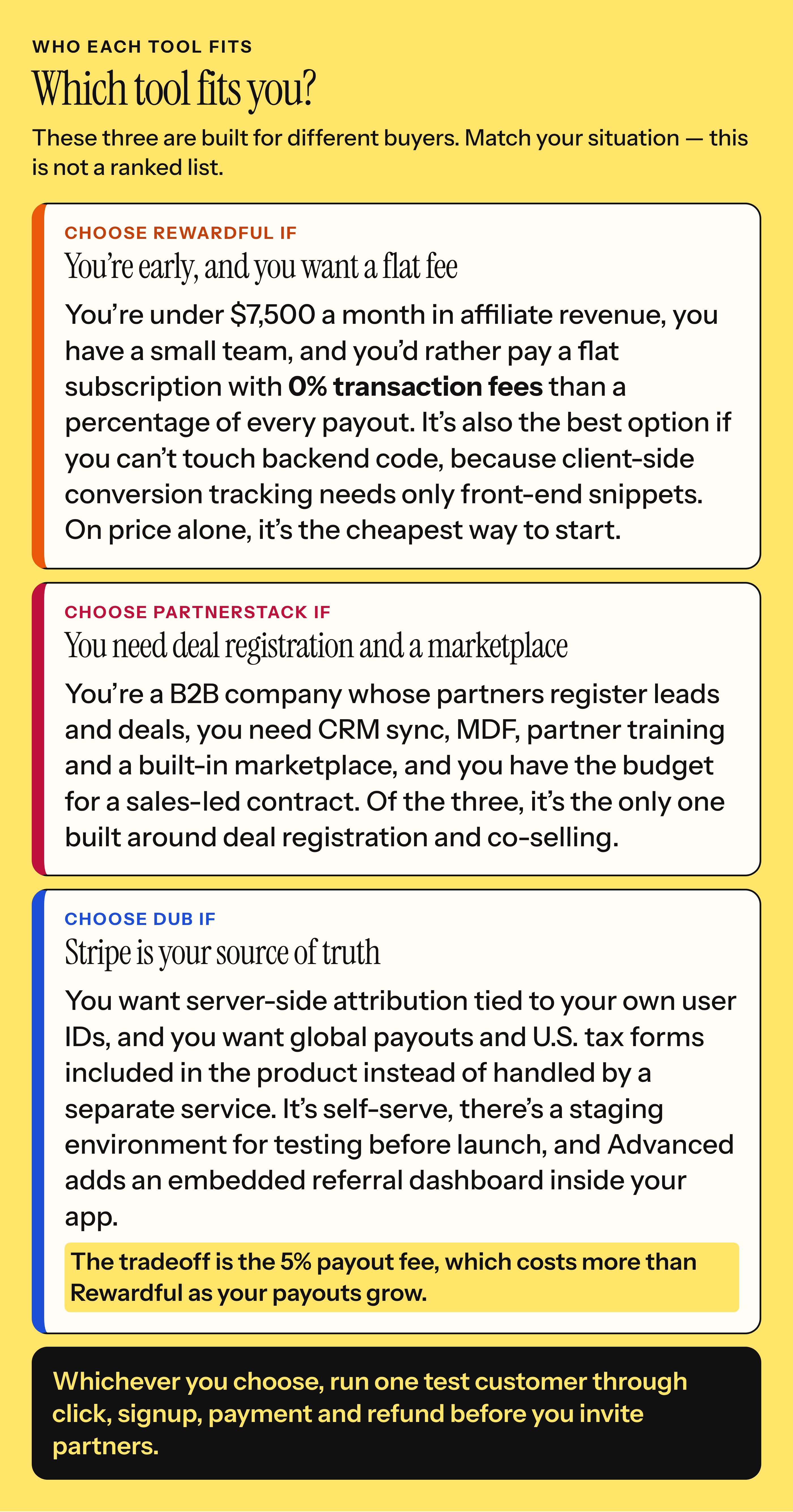
Rewardful, if you want the smallest bill. It's also the easier pick if nobody can touch your backend, within the front-end limits covered in the Stripe setup section above.
PartnerStack, if your partners register leads and deals, you need CRM sync, MDF, partner training and a marketplace, and you have budget for a sales-led contract. It's the only one of the three built around deal registration and co-selling (pricing).
Dub, if you want attribution tied to your own user IDs on the server, and you want the tax forms spelled out rather than implied. You can test it against a Stripe sandbox before launch (testing docs), and Advanced adds an embeddable referral dashboard. You pay for that in the 5% fee, on every payout.
Whichever you pick, push one test customer through a click, signup, payment and refund before you invite a single partner. Each tool's bill at $2k, $10k and $50k is in affiliate software pricing for 2026.
Try Dub Partners: https://refer.dub.co/shamil (Affiliate link - I may earn a commission)
Not verified
- PartnerStack's Launch, Growth and Enterprise prices and fee rate, any renewal increase, its network size and partner withdrawal fees. Spark's $0 a month plus 10% is the only published price.
- How any of the three behaves hands-on.
- Partner-side fees on Dub payouts.
About the author
- Independent notes on SaaS affiliate and referral tracking: pricing, Stripe attribution, refunds and payouts. Sourced from each vendor's own docs.
Comments
Join the discussionNo comments yet. Be the first to comment.